Pages

Thursday, August 28, 2025

America 250!


A beautiful patriot spy. A dangerous British officer. A passion spanning the tumultuous birth of a nation. Thrilling, heart-wrenching, romantic, the American Patriot Series will leave you breathless... 

With the America 250 celebration beginning in just a few months, brush up on your history and learn more about our Revolution while being vastly entertained! 

In this vivid retelling of our nation’s founding, the actual historical events, including the real British and colonial leaders who provided the catalyst for them and breathtaking moment-by-moment recreations of pivotal battles, converge with two compelling characters in a suspense-filled story of espionage, intrigue, and romance. On the ruins of war and loss, Elizabeth Howard and Jonathan Carleton will build an enduring legacy of love, hope, faith—and freedom!The American Patriot Series by J. M. Hochstetler sweeps readers into a tumultuous world of revolution.

The American Patriot Series is the only truly comprehensive fictional series on the American Revolution. Painstakingly researched using a wide range of primary resources as well as the latest popular and scholarly histories of the American colonial and Revolutionary periods, it contains a highly engaging and accurate account of the founding of the United States. While the series is written for adult readers, it is also appropriate for students from middle school through college age. The books of the American Patriot Series will engage students and bring history alive in a way that non-fiction texts cannot.

AUTHENTIC DIVERSITY

At the time of the Revolution the American colonies were already a melting pot of racial, ethnic, and religious groups. The American Patriot Series accurately depicts this diversity by portraying the involvement of women, African Americans, Native Americans, and other groups in the struggle for independence.

CHRISTIAN FOUNDATIONS

The American Revolution and the establishment of the United States are based solidly in the Christian faith of our founding generation, as innumerable primary resources document. It is therefore appropriate for the American Patriot Series to reflect those crucial aspects of our nation's founding by accurately depicting the beliefs and values of those who sacrificed their lives, their fortunes, and their sacred honor to bring this nation to birth.

SERIES THEME

The overarching theme of the American Patriot Series, the life journey to find one’s true home in God’s kingdom, is one that will resonate with many readers. While enduring the anguish of war and separation, Elizabeth and Carleton discover that, even more than the grand ideal of liberty and the deep intimacy of earthly love, they seek that eternal city of God where they will no longer be aliens and strangers, but citizens. As events out of their control rush toward a fateful climax, they learn that true peace and lasting freedom are found in God alone.

Friday, October 11, 2024

New Award!

 Daughter of Liberty finaled in the prestigious American Legacy Book Awards last spring! I neglected to post the news on the blog, so here it is!


Friday, April 26, 2024

I have a new interview up on Christine L. Henderson's blog Reading and Writing Books! We had a fun conversaation. Check it out and leave a comment! 

You'll see that she picked up the old, out of print edition of Native Son, still carried by some resellers on Amazon, but thankfully the new edition is easily found. 


Saturday, May 27, 2023


Memorial Day Sale on the definitive, thrilling historical fiction series on the American Revolution! For a limited time get books 1-3 and 7 for only $.99 ea. on Kindle. Suitable for high school through adult readers. 

“If you are a fan of Rev War novels, 18th century history, or gripping good storytelling, start with Daughter of Liberty. You have a lot of great reading in store and memorable characters to meet.” —Lori Benton, best-selling author of Shiloh.

Wednesday, April 5, 2023

Weather that Affected the Revolution: A Storm Ends the Siege of Boston, 1776

View of Boston from Dorchester
View of Boston in 1776 from Road to Dorchester
While researching the Revolution I was struck by the number of weather events that in some way impacted the war’s course. My last post looked at a phenomenon that affected the New England states in May 1780, spreading dread and confusion among those who either experienced it or heard descriptions of it. Today I’m going to begin a series focused on other weather-related events that had a notable effect on the combatants. We’ll start with one at the war’s beginning that’s portrayed in Native Son, Book 2 of The American Patriot Series.

Following the battles of Lexington and Concord in April 1775, American militias besieged Boston, which was occupied by the British Army under the command of General William Howe. General George Washington took command in July of what then became the American Army. The two armies remained in a stalemate through the summer, fall, and winter.

Colonel Knox Bringing the Cannons from Fort Ticonderoga

In January 1776, Colonel Henry Knox reached the American camp with heavy siege guns and gunpowder that had been dragged on sleds across the snow all the way from captured Fort Ticonderoga. There was still not enough gunpowder to sustain a bombardment long enough to drive the well-entrenched British out of the city, however. And with the ground frozen at least a foot deep, it would take more than one night to dig fortifications atop a steep bluff that overlooked Boston and its harbor, which was occupied by the British Navy. If they were seen by the enemy, work crews were sure to draw heavy fire. 

A brilliant solution was proposed: Place pre-made wooden frames on top of the ground, stuff them with hay, and cover them with dirt to construct parapets. Plans proceeded apace, and on March 2 the Americans began a bombardment from several points around Boston as a diversion. The British responded in kind, and the same took place the following night. Then at dusk on the 4th, with mild temperatures and under a clear sky and full moon, the Americans’ heaviest bombardment crashed into the town while 3,000 men worked feverishly to fortify two of the steep hills known as Dorchester Heights. That night they built the embankments, installed at least 20 pieces of artillery, cut down trees to make abatis and to provide a clear line of fire, and manned the fortification with a large number of well-armed soldiers. 

When the sun rose the next morning, the British found their position untenable. Howe’s only choice was to either attack the American fortifications or vacate Boston altogether. All during the day of March 5th, high-spirited American soldiers furiously strengthened and expanded their works until they were impregnable. Howe meanwhile drove forward plans to dislodge them despite his well-nigh certainty that an attack would end in a bloodbath worse than the one at Bunker Hill the previous spring.
National Park Service/©Louis S. Glanzman
Washington Reviews Dorchester Fortifications

That afternoon transports lined up in the harbor off Castle William facing Dorchester Heights. Aboard were the troops ordered to storm the American fortifications the following morning. In the evening, as rain began to move into the area, Washington reviewed the American defenses on the heights. 

He had no sooner returned to headquarters than a violent storm suddenly raged into the area. All night brilliant flashes of lightning and the rolling boom of thunder shook Boston and its environs. A heavy gale blew torrents of rain and snow horizontally, tearing limbs from trees, wreaking destruction on land and sea, and terrifying residents. Its fury did not abate until the inky sky finally began to lighten toward a sullen dawn. 

Washington enters Boston
Washington Enters Boston
The new day revealed what the storm had wrought: The gale had torn several British troop transports from their anchors, driving them afoul of each other and the rest of the ships. Even those ships that suffered lesser damage were rendered useless for the planned assault. 

Howe immediately began preparations to evacuate his army. On March 17, the heavily laden British ships slipped down the harbor toward the sea. The following day Washington took possession of Boston, formally ending the siege eleven months after it began.


Wednesday, October 19, 2022

New England's Dark Day

Dark Day mural, painted by Works Progress Administration artist
Delos Palmer in Stamford, Conn., Old Town Hall.

In Forge of Freedom Carleton relates an account he heard of a strange, unsettling early darkness that had descended over the New England states a few weeks earlier. This is, in fact, a real historical event that occurred on May 19, 1780. 

The weather had been cool in the north for most of the preceding month. Although the sky remained clear, a dirty yellow tinge colored it, and for several hours after sunrise and before sunset the sun held a reddish cast. But what happened that Friday morning was completely unexpected.

The morning began mostly cloudy, and shortly after 9 o’clock “came on an appearance over the whole visible heavens a light grassy hue nearly the color of pale cyder,” according to one contemporary diary entry. Around noon a darkness descended that was so deep the birds sang their evening songs, then fell silent and retreated to their nests. Frogs began to peep. Chickens returned to their roosts and cows to their stalls. In some areas an almost impenetrable darkness made travel difficult, if not impossible.

Image from Our First Century, 1776-1876, Richard Miller Devens (1880)

“It was so terrible dark that we could not see our hand before us,” one diary entry reads. A letter sent from Exeter, NH, records that “the inky black was probably as gross as ever has been observed since the almighty first gave birth to light….A sheet of white paper held within a few inches of the eyes was equally invisible with the blackest velvet.” A professor at Cambridge, MA, observed that “In some places the darkness was so great, that persons could not see to read common print in the open air….The extent of this darkness was very remarkable.”

A minister at Westborough, MA, wrote, “By 12, I could not read anywhere in the house—we were forced to dine by candle light. It was awful and surprising.” A professor in New Haven, Connecticut, reported, “the greatest darkness at least equal to what was commonly called candle-lighting in the evening. The appearance was indeed uncommon, and the cause unknown.” He also noted that low clouds took on “a strange yellowish and sometimes reddish appearance…an unusual yellowness in the atmosphere made clean silver nearly resemble the colour of brass.” Others remarked the effect on the colors of grass and foliage: “An uncommonly lovely verdure, a deepest green, verging on blue” and “so enchanting a verdure as could not escape notice, even amidst the unusual gloom that surrounded the spectator.”

The eerie darkness extended north to Portland, Maine, and west into the Hudson Valley. It was noticeable as far south as New York City and northern New Jersey, where General George Washington noted it in his diary while camped at Morristown. It didn’t extend to Philadelphia but seemed to center around northeastern Massachusetts, southern New Hampshire, southwestern Maine, and coastal areas bordering the region. 

The unprecedented, unexplained darkness caused considerable consternation and even terror, as you can imagine. Many people feared God’s anger or demons to be the cause. It was variously reported that “persons in the streets became melancholy and fear seized all”, and the darkness “caused great terror in the minds of abundance of people”. Members of the Connecticut Legislature believed the Day of Judgment was at hand and adjourned for the day. Weeping crowds thronged into churches to pray.

View of Boston Harbor
At the time there were no certain means to determine what caused this strange event, which lasted only for one day. There were clues, however. Rain fell that day across several areas, and at Ipswich, MA, rainwater collected in tubs was covered by black scum like ashes and had a strong sooty smell. The air in Boston smelled like a “malt-house or coal-kiln”. Noting that the water was thick, dark, and sooty, appearing like the black ash of burned leaves, but “without any sulphureous or other mixtures,” Professor Samuel Williams of Cambridge, MA, theorized that the darkness was due to the atmosphere being highly charged with vapors. 

Williams was essentially correct, though he had no way to definitively prove it. The mystery reigned for many years before finally being solved in 2007. That year a team led by Richard Guyette, a forestry professor at the University of Missouri, used a dating technique called dendrochronology to determine that in the spring of 1780 a huge fire swept across a large area north of Ontario, today Algonquin Provincial Park. It’s now known how smoke from large fires interacts with the atmosphere and wind patterns, and Guyette concluded that this was the likely cause of New England’s strange dark day. 


Thursday, August 11, 2022

Maps!


One of the fun things about doing this series, in addition to the covers, has been the maps that are included. I’ve loved maps since my class began to study them in elementary school social studies, so it’s been a delight to work on these.

Obviously a professionally published historical series needs maps, and I’ve included at least one in every volume. My illustrator, Jim Brown of Jim Brown Illustrations, is wonderful to work with and does a smashing job creating the maps I need. Here’s the latest one: the Siege of York, which began on September 29, 1781 and ended on October 19, finally forcing the British to begin negotiations to end the war. By the way, the town was named York until some years after the war’s end, and that’s its name in Forge of Freedom.

The map shows the final positions and fortifications of the combined American-French Army and the British at York and across the York River on Gloucester Point, where Lt. Col. Banastre Tarleton commanded a small fort and entrenchments. Several of the British ships that were blocked in the river while guarding the communication lines between York and Gloucester Point are also shown. French bombardment sent the HMS Charon up in flames along with several other ships in her immediate vicinity. On the inset, HMS Guadeloupe had to be scuttled by the British to prevent her capture. To the right of York, Redoubts 9 and 10 were the object of the American and French final assault on October 14 that allowed the allied army to extend their lines so close to the British lines that they had no choice but to surrender. Forge of Freedom includes that assault in the depiction of the battle. 

 So what do you think? It’s it pretty? I'm a happy girl!


Friday, July 1, 2022

Update on Forge of Freedom

Yesterday I finished the full edit of Forge of Freedom! And now that I have the final page count—523 pages! Yikes!—my designer can finalize the cover’s spine width. As Marisa said, “That’s a big book.” Yes, it is. And I don’t expect to ever do that again! 

Even the back cover is going to be gorgeous, as you can see in the preliminary at the left. The text isn’t correct at this point and will be changed, so ignore that. The image of Muchalls castle in Scotland appeared in previous posts and is in the sidebar at right. It’s the perfect stand-in for the manor house at Jonathan Carleton’s Virginia estate, Thornlea, and Marisa did a fantastic job of enhancing the image so it’s exactly as I envision it!

Forge is long, indeed, but the page count does include the frontmatter and the historical notes, appendix, and glossary at the end. The story itself is just slightly over 500 pages. I knew from the beginning this was going to be a hefty tome since there was a lot of ground to cover, and I really did not want to end up adding an eighth volume. I’m sure readers will be grateful for that!

Because my purpose is to accurately portray God’s working in history through exciting stories, I wanted to at least touch on the main historical events, delving more deeply into the most critical ones. And, of course, there are Jonathan’s and Elizabeth’s personal stories, their life together, and their families that needed to be covered, as well as those of the major secondary characters. Not to mention loose ends to tie up from the previous books. I think I hit the most important ones.

I pray that this final volume will carry readers along, offer insights into the characters that speak to their own lives, and entertain, inspire, and deeply touch the heart. I found encouragement and blessing in the writing of it, and so I commend this story, this series, to you, dear readers. I am beyond grateful for everyone who has written reviews and for those who have encouraged and cheered me on when the work seemed too heavy to carry.

And now proofreading is next. My mapmaker is working on the Battle of York (called Yorktown today). At right is the map mine is based on. I also have several endorsements already, with several more coming. As soon as I have these last bits in hand, I’ll finalize the text for upload to my printer and online sites for the print edition. Christianbook has Forge up for preorder and should be able to send orders out slightly before the official release on October 1. And, of course, it will be available on Amazon and Barnes & Noble too.

The ebook edition still needs to be created and uploaded as well. It will most likely release about the same day as the print edition. And then there's promo, of course. Lots of promo—my least favorite task. Ugh. I sure do appreciate the power of word of mouth, and I would appreciate it immensely if you would let your contacts who love historical/romance fiction know about the series. And please do post reviews on Amazon and elsewhere! They help so much.

It’s going to be hard to say farewell to the characters I’ve come to know so well through the years I’ve spent researching and writing this series—from 1984 to the present. How I have come to love them! They’ve become so real to me and dear friends, and I hope to you too. I’m already mourning their loss, but it is time for me to move on to new projects, and I’m beginning to think about what comes next.

Here’s the back cover blurb for Forge.

In the final volume of The American Patriot Series, the Americans’ war for independence concludes in triumph—and the renewed fight of the Shawnee for survival in their ancestral lands. From John Paul Jones’s epic battle with HMS Serapis, to the conflagration on the western frontier; a traitor’s bitter betrayal; and the decisive confrontation at Cowpens, events out of Jonathan and Elizabeth Carleton’s control spiral toward a fateful climax at Yorktown. Yet amid war’s harsh trials they discover that, even more than the grand ideal of liberty and the deep intimacy of earthly love, the cry of their hearts is for the true peace and lasting freedom that are found in God alone.


Monday, October 4, 2021

Cover Reveal!

Today is cover reveal day for Book 7 of the American Patriot Series, and voilà, here it is! I’ve been waiting to reach this stage of production for a long time, and I know many of my readers have been too! We’re making progress: Forge of Freedom is set to release in October 2022. 


I chose this image of General George Washington surrendering his commission as commander in chief of the Continental Army to Congress because it exemplifies the hallowed tradition of our republic that the civil authority of our government is in control of the military establishment instead of the other way around, unhappy examples of which are evident in a number of countries around the globe. Bless our Founders for their wisdom! This scene will appear toward the end of Forge of Freedom.

I gave fuller details on this painting by John Trumbull in a previous post, and you’ll find it here.  The original painting hangs in the United States Capitol rotunda in Washington D.C.

Please leave a comment. I’d love to have your feedback on the cover!


Monday, February 22, 2021

Cover Reveal for Lori Benton's Shiloh, Book 2 of the Kindred Series!

At last!! It’s finally time to reveal the cover of Shiloh, the second installment in award-winning author Lori Benton’s Kindred duology. And here it is! Don’t you just love this cover? It’s every bit lovely as Mountain Laurel’s! 

And speaking of book 1, if you’ve read Mountain Laurel, I know you’re looking forward to book 2 as much as I am! Shiloh releases on October 5 this fall and will be available for preorder on March 1.

Shiloh is a rich historical novel of faith, hope, and second chances. Below is a preview of the story. 

DECEMBER 1795 

A year has passed since Ian Cameron reluctantly sent his uncle’s former slave, Seona, and their son, Gabriel, north to his kin in Boston. Determined to fully release them, Ian strives to make a life at Mountain Laurel, his inherited plantation, along with Judith, the wife he’s vowed to love and cherish. But when tragedy leaves him alone with his daughter, Mandy, and his three remaining slaves, he decides to return north. An act of kindness on the journey provides Ian the chance to obtain land near the frontier settlement of Shiloh, New York. Perhaps even the hope for a new life with those he still holds dear.

In Boston, Seona has taken her first tentative steps as a freewoman, while trying to banish Ian from her heart. The Cameron family thinks she and Gabriel should remain under their protection. Seona’s mother, Lily, thinks it’s time they strike out on their own. Then Ian arrives, offering a second chance Seona hadn’t dared imagine. But the wide-open frontier of Shiloh feels as boundless and terrifying as her newfound freedom—a place of new friends and new enemies, where deep bonds are renewed but old hurts stand ready to rear their heads. It will take every ounce of faith and courage Ian and Seona can muster to fight for their family and their future . . . together. 

~~~

If you haven’t yet read Mountain Laurel (Kindred #1), you don’t want to miss it! Be sure to grab a copy before Shiloh releases so you can catch up with the action. 

NORTH CAROLINA, 1793

Ian Cameron, a Boston cabinetmaker turned frontier trapper, has come to Mountain Laurel hoping to remake himself yet again—into his planter uncle’s heir. No matter how uneasily the role of slave owner rests upon his shoulders. Then he meets Seona—beautiful, artistic, and enslaved to his kin.

Seona has a secret: she’s been drawing for years, ever since that day she picked up a broken slate to sketch a portrait. When Ian catches her at it, he offers her opportunity to let her talent flourish, still secretly, in his cabinetmaking shop. Taking a frightening leap of faith, Seona puts her trust in Ian. A trust that leads to a deeper, more complicated bond.

As fascination with Seona turns to love, Ian can no longer be the man others have wished him to be. Though his own heart might prove just as untrustworthy a guide, he cannot simply walk away from those his kin enslaves. With more lives than his and Seona’s in the balance, the path Ian chooses now will set the course for generations of Camerons to come.

~~~

Shiloh also revisits several key characters from Lori’s debut novel, Burning Sky, and you’ll want to make their acquaintance too if you haven’t already. The good news is that there’s also plenty of time to meet the frontier denizens of Shiloh, New York, in the pages of Burning Sky before Shiloh’s October release.


Abducted by Mohawk Indians at fourteen and renamed Burning Sky, Willa Obenchain is driven to return to her family’s New York frontier homestead after many years building a life with the People. At the boundary of her father’s property, Willa discovers a wounded Scotsman lying in her path. Feeling obliged to nurse his injuries, the two quickly find much has changed during her twelve-year absence: her childhood home is in disrepair, her missing parents are rumored to be Tories, and the young Richard Waring she once admired is now grown into a man twisted by the horrors of war and claiming ownership of the Obenchain land.
 
When her Mohawk brother arrives and questions her place in the white world, the cultural divide blurs Willa’s vision. Can she follow Tames-His-Horse back to the People now that she is no longer Burning Sky? And what about Neil MacGregor, the kind and loyal botanist who does not fit into in her plan for a solitary life, yet is now helping her revive her farm? In the aftermath of the Revolutionary War, strong feelings against “savages” abound in the nearby village of Shiloh, leaving Willa’s safety unsure.
 
As tensions rise, challenging her shielded heart, the woman called Burning Sky must find a new courage--the courage to again risk embracing the blessings the Almighty wants to bestow. Is she brave enough to love again?

Be sure to check out all three of these powerful, heart-capturing stories!

Friday, February 5, 2021

Blog Header

As you can see, the blog has a new look! The header image is John Trumbull’s American General George Washington resigning his commission as commander-in-chief of the Continental Army to the Congress of the Confederation at Annapolis, Maryland, on December 23, 1783.

Trumbull depicts Washington’s resignation as the commander in chief of the army on December 23, 1783, to the United States Congress, then meeting at the Maryland State House in Annapolis. At this time our government was a confederation, rather than a republic, as it became in 1788. That Washington resigned his commission was highly significant to our nation’s history in that it established civilian, rather than military rule and consequently a dictatorship. I’m sure we’re all extremely grateful for our Founders’ wisdom!

In Trumbull’s painting, Washington stands with two of his aides as he addresses the president of the Congress, Thomas Mifflin, and others, such as Elbridge Gerry, Thomas Jefferson, James Monroe, and James Madison. Martha Washington and her three grandchildren are shown watching from the gallery, but they were not, in fact, present for this momentous event.

The following year, Washington was elected the first president of the new republic.

The painting was commissioned in 1817 and placed in the United States Capitol rotunda in Washington D.C. in 1824, where it is still located today. Its imposing dimensions are 144.00 in × 216.00 in. 

Have you had the privilege of seeing this painting in person? I haven't, but I’d certainly love to!


Friday, May 8, 2020

Thornlea: First Glimpse

As I promised, today I’m posting the first glimpse of Thornlea that readers will encounter in chapter two of Forge of Freedom. This is set in Elizabeth’s point of view, and I’ve removed the dialog and most of the action that will be woven throughout. It’s still in rough draft, and I’ll probably end up doing some reorganizing and rewording. Take that into account and please be charitable!
~~~

Chapter Two


I might as well be in Scotland.

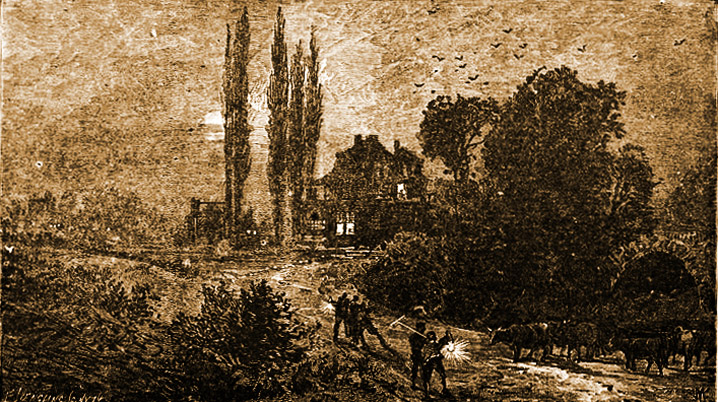
Smiling, Elizabeth Howard Carleton studied the rear of the brooding, towered building that loomed before her. The imposing grey limestone manor of her husband’s Virginia estate could not possibly have looked more like a Highland laird’s domain. Adding to the effect were the lilting strains of fiddle and pipe that reached her from the back of the nearby summer kitchen, where several of the Scottish and Irish servants were taking a brief break from their duties to dance an exuberant jig.

She had stepped out through the side door of the large stone carriage house, converted for use as the Rangers’ hospital, only to stop, as she often did, arrested by the picturesque view. Yet even in these peaceful surroundings war made its uneasy presence known. Indeed the vista would have given the impression of a blissful, dreamlike idyll were it not for the uniformed troops and Indian warriors in native dress riding or striding purposefully along the pathways and lanes between the property’s buildings.

Although remote in its mountain fastness, the estate was as bustling as any town. The manor’s sweeping emerald lawns were currently occupied by Carleton’s brigade of Rangers, nominally under the command of General George Washington, but in reality an independent force that Carleton personally funded and that answered to him alone. What she could see from where she stood behind the manor’s south wing, however, was but a tiny portion of the more than 20,000 acres he owned, spanning verdant meadows all along the broad valley’s floor, where his extensive herds of horses and cattle pastured, and vast mountain forests that blanketed the high ridges on either side.

A cool breeze tugged at her plain blue linen petticoats and white apron and teased strands loose from the riot of dark auburn curls that pins and her simple white cap could not restrain. It teased as well the smoke rising all across the sprawling camp from fires hung with steaming kettles for the evening’s mess and from the kitchen’s chimney where supper simmered for the manor’s residents and servants. The afternoon was rapidly waning, and from behind the western mountain wall of the Blue Ridge, lingering sunrays streaked the sky’s impossibly clear blue overhead and cast long fingers of shadow across the valley, setting the landscape in vivid relief.

Hues of scarlet, crimson, and russet, citron and amber drew her gaze to the tall trees between the buildings and edging the meadow the manor occupied, enclosed by a wide loop of the Thorn River. The brilliant leaves flamed among the dusky greens of pine and cedar and holly, the chill wind fanning them like fire.

She drew in a deep breath of the crisp, smoke-tinged air, musing that the place looked as though it dated to a distant century. Yet it had been built by Carleton’s uncle, Sir Harrison Carleton, only forty-seven years earlier, in 1732. Sir Harry, a Scottish laird’s eldest son, had fled his homeland for Virginia in 1715 after the British defeat of the Highland clans and death of his father at Sheriffmuir, leaving his young brother, Carleton’s father, to assume the clan laird’s heredity title of marquess. On her and Carleton’s arrival there from France in mid July, he had explained that it had been Sir Harry’s intent to recreate his ancestral home.

A pang pierced her at the memory. If only Carleton could have stayed with her there! Knowing too well the urgent mission that had again wrested him from her arms, she could not oppose his leaving. But at times such as this the sense that he was in very great danger overwhelmed her, and a terrible fear pierced her heart and stole her breath. She added another anxious, silent plea for his safety to those constantly hovering in her thoughts.

Reminding herself that the Almighty’s purpose for them was always right and perfect, even when it did not seem so, she pressed her hands against her back and stretched to ease its ache. A protesting ripple caused her to grimace, and she ran one hand along the curve of her rounded belly, smiling at the surprisingly vigorous kick beneath the tight skin and muscle.

When the babe quieted she returned her attention to her surroundings. Rows of tents interspersed the estate’s many outbuildings, and the stillness of the peaceful scene was broken by the soft hum of voices, distant rattle of wagons and harness,  nearby plop of hoofs and scuff of footfalls on the graveled lanes, and occasional chime of birdsong. To her left the summer kitchen surrounded by the kitchen gardens lay outside the south wing’s entrance, with the laundry house a short distance behind. Off the main building’s far end she could just see the edge of the graceful terraces that extended its width down the gentle slope to a wide lawn where a stone bridge spanned the river near the springhouse. On the river’s far side the ridge’s flank began to rise through dense forest, first gently, then steeply to the shadowed summit of the western ridge.

She turned to glance southward where a smokehouse, still, capacious barns, expansive stables and paddocks filled with sleek horses, smithy, other workhouses, and clustered former slave cabins ranged farther down the broad Thorn Valley. Directly across on the flank of the eastern ridge, orchards and a vineyard denuded of most of their bounty this late in September blanketed a warm slope open to the sun.

She had not followed the road all the way to the end of the valley because of her pregnancy and the warning that within a mile the road dwindled to a narrow, rutted, stony path difficult to traverse except on foot, and then with difficulty. But she longed to see the place where she had been told that the river’s headwaters rose from a trickle below a narrow gap in the ridges’ folds and cascaded down a rocky watercourse before widening as it snaked back and forth across the tree-dotted meadows of the valley floor to finally pass through its broad mouth on the way to join the larger Staunton River. That would have to wait until the spring.

And by then, in God’s mercy, Jonathan will have returned, and our babe will be safely born.
~~~

Please let me know what you think of this section. Can you see the scene vividly, or would you suggest improvements? I always appreciate honest critiques kindly given!

The images are my own or in public domain.

Thursday, May 7, 2020

Constructing Thornlea: A Visit to Muchalls Castle

Muchalls Castle front view
In yesterday’s post I described my efforts to set Jonathan Carleton’s Virginia estate in a specific area of the Blue Ridge Mountains. Today I’m going to describe what the exterior of the manor house looks like. The intention of Carleton’s uncle and adoptive father, Sir Harrison Carleton, was to build a structure that visually evoked the Highland seat of their Scottish clan. L-plan castles were common from the 13th to the 17th century in the British Isles and across Europe, favored because they offer strategic vantages on the adjacent walls from which defenders can blanket the fortress’s entrance with deadly crossfire in case of attack. So it seemed a logical option for an 18th-century reconstruction of Clan Carleton’s manor house in Virginia.

After searching the internet for images of Scottish castles, I fortuitously came across one that closely resembles what I have in mind: Muchalls Castle which overlooks the North Sea in the countryside of Aberdeenshire, Scotland. Unfortunately I wasn’t able to find many interior shots, so we’ll have to focus mainly on the exterior. But good enough. Let’s take a tour!

Rear view showing back of west extension
This castle’s lower level is the original 14th-century Romanesque, double-groined tower house built by the Frasers of Muchalls. A barrel-vaulted passage gives access to a reception chamber where the laird would meet with business visitors, storerooms, a guard room, and a dungeon. This level also houses the medieval groin-vaulted kitchen with its original flagstone floor and huge walk-in fireplace. Its interior wall is much thicker than those in the rest of the castle to support the upper levels, which it’s speculated might once have included a defensive tower. The wall also encloses a concealed spiral staircase that servants would have used to carry food up to the dining room above.

View of bartizans
The Frasers sold the property to the Hays in 1415, but by 1619 it had passed to the Burnetts of Leys. The 17th-century castle was begun by Alexander Burnett and completed by his son, Sir Thomas Burnett, in 1627. The second floor (first floor in Britain) was built over the original structure. On the corners of the castle’s upper levels Burnett added round turrets supported by corbels, two of which are shown at left. Called bartizans, they form circular nooks with small lookout windows inside many of the bedrooms.

Rear of side wing with additions
The castle’s original defensive features include numerous arrow slits in its exterior walls. Burnett also added a subterranean crypt, massive chimneys on the building’s crow-stepped gable ends, an entrance courtyard with crenellated walls and two sets of triple gunloops flanking the arched gates, and high stone-walled terraced gardens. Subsequent owners expanded the structure to the present day four-story castle with a wing extending from the west end, visible in the photo above and the one at right showing the rear of the side wing. Thornlea lacks those additions, so you’ll have to imagine it with a flat exterior wall along the side wing and the end of the main wing.

Great Hall plasterwork over-mantel and ceiling
The second level includes most of the main reception rooms, including the great hall, a drawing room and a study. The ceilings of these rooms are totally covered in original 17th-century plasterwork featuring coats of arms and biblical and other historical figures. Dating to 1624 and in practically perfect condition, they’re considered among the finest examples of plasterwork in Scotland. The great hall fireplace has an original plaster over-mantel with Egyptian-style caryatid figures and King James’ Arms. It’s so large that one can walk erect inside it, and a bench is built in where several people can hold a meeting. It also contains a hidden feature called the Laird’s Lug, a secret listening system that allowed the laird to overhear conversations in the great hall from his suite directly above! Let the intriguer beware!

The third level consists of a number of bedrooms including the Laird’s Bedroom, the Priest’s Bedroom; the Queen’s Bedroom, in case she were to visit; and even the Queen’s Winter Bedroom. Each of the bedrooms has a fireplace and what would have been dressing rooms in the 17th century, now converted to bathrooms.

The exterior differences are minor. Faced with Virginia limestone, Thornlea appears grey rather than brown, and, of course, doesn’t have a rear addition. But otherwise, Muchalls Castle is a very good stand-in for the manor. Tomorrow I’m going to post an excerpt from the beginning of Chapter Two that will hopefully help you to visualize the estate and manor more vividly. Be sure to join me to take a look!

Images of Muchalls Castle are from Wikipedia and Alchetron and are in the public domain.

Wednesday, May 6, 2020

The Road to Thornlea

In Public Domain
Catskill Clove by Asher Brown Durand, 1864
When you write novels you’re going to need names. Lots of them. For novels based on real historical events like The American Patriot Series, some of your characters and settings might be historical figures and places, which happily eliminates the need to name them. But that leaves your fictional characters and the settings they inhabit, all of which you want to be memorable, including their names. And choosing the lot of them can be hair-rippingly frustrating, especially if you’re obsessive like I am!

Thankfully some do come easily, like Elizabeth Howard. But other names require considerable pondering, research, making lists, combining and recombining different first and last names if they’re people, and striking out options until the character or place steps forward and reveals itself to you. Like Jonathan Carleton, for instance. Just like his character in the series, he was stubbornly, exasperatingly enigmatic, and I had to wait, tapping my foot impatiently, for him to finally emerge from the mists. And then he rather exploded onto the page, the rascal!

But occasionally a character or place is already there, fully named, when you arrive, as though they were given, as though they existed in the dim recesses of time long before they stepped to the fore. Charles Andrews and James Stowe were two of those characters. And the name of Carleton’s Virginia estate, Thornlea, was also one simply “given.” In the chapter in Daughter of Liberty where Elizabeth and Carleton first meet, Andrews refers to the estate and gives a brief description.

“Oh, it’s just a modest plot of land—twenty thousand acres or so running up into the Blue Ridge. Most of it is heavily forested, but enough is cleared to pasture about three hundred head of cattle and a hundred horses. I swear, the main house rivals the great manors of England, and the countryside around it is second to none for beauty.”

All of that simply spilled out onto the page without any forethought. I had no idea.

Pfly / CC BY-SA (https://creativecommons.org/licenses/by-sa/2.5)
Roanoke River Watershed 
Nor, in spite of scattered references to “Thornlea” in the previous books of the series, did I have any idea whatever of exactly where this estate would be set, other than in the Blue Ridge Mountains of Virginia, or what it would consist of. I only knew vaguely that at some point the story would go there. Well, Forge of Freedom is the last book in the series, and the hour of reckoning has come! So I’ve had to buckle down and try to bring it to vibrant life.

I discovered early on that I would have to locate an approximate real-world area where the estate is set to figure out its landscape, flora, and fauna. I also had to take into account the events of the British Southern Campaign since Carleton would be involved in opposing those actions and Thornlea would be his base of operation. A detailed topical relief map of Virginia led me to a lovely deep valley carved into the Blue Ridge just south of the Roanoke River, which back then was the Staunton River, and a short distance north of the Poor Mountain State Natural Area Preserve. Above is a map of the Roanoke River watershed to give you an idea of the general location. As you see, it’s strategically located not far from the North Carolina Border. In order to explain the name Thornlea, this became Thorn Valley, named for the hawthorn and black locust trees growing thickly in it (thorn), and for the meadows (lea) where Carleton’s herds of livestock graze. Who knew?! And where in the world did that come from three decades ago when I first started writing Daughter of Liberty with no idea of making it into a series??? A moment of serendipity or something else? Whatever the case, the river that runs through it consequently became the Thorn River.

In Public Domain
Landscape Beyond the Tree
by Asher Brown Durand 
For the sake of visualization, I searched for historical paintings of similar mountain landscapes to stand in for Thorn Valley. For now, several of Asher Brown Durand’s 19th century landscapes of the Catskills on the northern end of the Appalachian chain fit the bill pretty well. Shown at the top of the post is a view that looks much the way I envision the overlook at the valley's entrance. The one to the right portrays what might be a vista of the valley floor on the road leading toward the estate.

Now to figure out what the manor house and surrounding establishment look like. Which means drawing a map of the estate, finding exterior photos of historical Scottish mansions or castles that look like what I’m imagining, and then drawing floor plans of the house. So far I’ve come up with a rough map of the estate, which could stand to be cleaned up but is good enough for me to keep the characters’ movements consistent. However, the house will have 4 stories, which means the floor plan is going to take a bit of work to figure out so I can have my characters move around in it without pesky continuity errors cropping up.

In tomorrow’s post, I’m going to share photos of Thornlea’s double and the first, currently somewhat rough, descriptions woven into Chapter Two of Forge of Freedom. Please let me know your thoughts about all this, and be sure to join me back here tomorrow to take a closer look!

Images are from Wikipedia and are in the public domain.

Sunday, June 2, 2019

Print and Ebook Editions Now on Sale!


Refiner’s Fire is now available in print and ebook editions at the following retailers. It’s only $1.99 on Kindle and Nook through the month of June before going to our standard ebook price of $2.99. Daughter of Liberty and Native Son will continue at $.99 until June 15, so if you haven’t caught up with the series yet, now’s the time to dive in with books 1 and 2!

Wednesday, May 22, 2019

Refiner's Fire Editions Available for Preorder

Refiner’s Fire Kindle Edition is now available for preorder on Kindle, releasing May 31 and on sale for only $1.99 until July 1, when it goes to the regular price of $2.99. The print edition will be stocked and available for purchase by the same date at $12.00. 

The Nook edition is also on sale for only $1.99 during that period. 

For those who are eager to get their hands on the print edition, Christianbook.com is already shipping, and they’ll release both Kindle and Nook editions on May 31. 

I think you’re going to enjoy the very happy turn Elizabeth and Jonathan’s story takes in this installment!

Wednesday, May 8, 2019

Sale on Daughter of Liberty and Native Son!

A beautiful and daring patriot spy determined to gain the intelligence the Sons of Liberty desperately need. A handsome, dangerously charming British officer with secrets of his own and a mission to learn her true loyalties. A passion that could lead them both to the gallows. Set amid the tumult of the American Revolution, the American Patriot Series will leave you breathless …


In celebration of Refiner's Fire release, both Daughter of Liberty and Native Son are on sale for only $.99 on Kindle, Nook, and Christianbook.com through mid June, and the rest of the volumes are only $2.99. Now is the perfect time to get caught up with this series if you haven’t read it yet!

Here are several terrific endorsements for Refiner's Fire!

“Refiner's Fire is not simply a story but an experience. Within its pages are all the upheaval, suspense, heartache, and romance that make the American Patriot Series unforgettable. The author’s breadth and scope of our founding history is truly remarkable and each finely tuned character seems lifted from the actual historical record. Extraordinary!” —Laura Frantz, Christy-award winning author of The Lacemaker

“Painstaking attention to research and detail, vivid setting, peeks into some of the most obscure corners of an otherwise familiar history, all overlaid with a grand, sweeping love story that will break your heart before it takes your breath away . . . this book (and series!) has it all. If you’re a fan of historical fiction and romance and haven’t yet discovered this author, don’t wait another minute to do so!” —Shannon McNear, 2014 RITA® finalist and author of The Cumberland Bride,
#5 of Daughters of the Mayflower

Refiner's Fire is an absolutely thrilling read! J.M. Hochstetler once again takes readers deep into the turbulent days of the American Revolution, bringing to life the battles, the spies, and the intrigue that belong solely to our forefathers and their struggle for our burgeoning country. Hochstetler's rich description, strong and unique characters, and impeccable attention to historical detail leaves readers wonderfully satisfied yet longing for more. Fans of historical fiction will adore this newest installment in the American Patriot Series. —Michelle Shocklee, author of The Widow of Rose Hill

“J. M. Hochstetler’s in-depth research and masterful writing combine for an exceptional novel, filled with history, intrigue, and romance. Refiner’s Fire is an engaging and most satisfying read. As Book 6 in the American Patriot series, Refiner’s Fire can be read as a standalone, yet the preceding novels fill in much detail, making Refiner’s Fire even more enjoyable. It is rare to read a series with the intensity of historical understanding that you will find within the pages of the American Patriot Series. From every vantage point—the Native Americans, to the British, to the Colonial Americans—the complexity of the political and cultural ramifications brings a greater depth of understanding to the bigger picture than you will find in most historical novels. A series well worth mentally devouring.” —Elaine Marie Cooper, author of Love's Kindling

Monday, December 3, 2018

Colonel Tye, Black Loyalist Guerrilla in the American Revolution

At the beginning of the American Revolution, the British offered freedom to any black slaves who joined them to fight the Americans. Of the many slaves who managed to escape and ended up as soldiers, sailors, or workers in the British army, one became the most feared and respected guerrilla commander of the Revolution. Born in 1753, Titus was the slave of a cruel, quick-tempered Quaker named John Corlies of Shrewsbury in eastern Monmouth County, New Jersey. When the Quakers in that region began to free their slaves, Corlies refused to do so and by 1775 was one of the few remaining Quaker slaveholders in the county.

Ethiopian Regiment.soldier
by Bantarleton
Things changed when on November 7, 1775, after being forced to flee onto a British warship off Norfolk by the patriot militia, Virginia’s royal governor, Lord Dunmore, issued a proclamation offering emancipation to any slaves belonging to rebels who were willing and able to bear arms for the crown. Twenty-two-year old Titus escaped the following day, joining a flood of blacks from Monmouth County who made their way to Norfolk to enlist in Dunmore’s newly formed Ethiopian Regiment. In spite of warnings by outraged slaveholders that runaway slaves would be executed and that any who joined the British would be sold to sugar cane plantations in the West Indies if caught, within a month about 800 slaves had escaped, many bringing their families with them.

The Ethiopian Regiment served in 1775 and 1776, and with its uniform emblazoned with “Liberty to Slaves” became a symbol of hope for black Americans. Although the men were most often used for foraging, constructing fortifications, and other work, they also saw battle. They fought effectively alongside the Regulars to defeat patriot militia forces at the Battle of Kemp’s Landing. After Dunmore’s defeat at the Battle of Great Bridge, he loaded his black troops onto ships of the British fleet headed for New York, where he hoped to give them better training. The cramped conditions led to the spread of smallpox, however, and with only 300 of the original 800 soldiers surviving, Dunmore disbanded the regiment in 1776.

Death of Major Peirson by John Singleton Copley
January 6, 1781
Nothing further is known of Tye until the Battle of Monmouth in June 1778, the first military action he’s known to have fought in and during which he captured an American militia captain. As the leader of the Black Brigade, an elite guerrilla unit of 24 men that served in New Jersey alongside the Loyalist Queen’s Rangers, he became known as Colonel Tye, an informal rank given out of respect since the British Army didn’t formally commission black officers in the 18th and 19th centuries. He and his band raided and plundered Shrewsbury the next month, capturing two of the town’s inhabitants. During the severe winter of 1779 they and the Queen’s Rangers provided protection for the British in their stronghold at New York City and launched raids to obtain food and fuel for the garrison.

Thomas Peters, Nigerian-born slave and black Loyalist
in British Black Company of Pioneers
By 1780 the Black Brigade had become a significant military force and the most feared Loyalists in New Jersey with a reputation as fierce and canny fighters. Tye’s familiarity with the area’s swamps, rivers, and inlets enabled his Black Brigade to strike swiftly and unexpectedly, and then disappear before the Americans could respond. In one week in June he led three raids in Monmouth County. On June 9, he and his men killed Joseph Murray, hated by Loyalists for executing captured Tories under a local vigilante law. On June 12, while Washington’s hard-pressed army fought the Regulars, he and his band made a daring raid on the home of militia leader Barnes Smock, captured him and twelve of his men without taking casualties, plundered their homes, destroyed their cannon, then took their captives to New York without being detected, thus depriving Washington of badly needed reinforcements and terrorizing local patriots. The British paid Tye and his men well for their efforts, sometimes as much as five gold guineas, and as a result of their exploits the number of slaves escaping to the British kept growing.

That September Tye and his Black Brigade attacked the home of Captain Josiah Huddy, an officer who had been wanted by the Loyalists for several years. Huddy and a friend, Lucretia Emmons, managed to hold off their attackers for two hours, until the Loyalists torched the house. Tye was shot in the wrist during the battle, a minor wound that became infected, and he died from gangrene within weeks.

With Colonel Stephen Blucke of the Black Pioneers in command, Tye’s raiders continued fighting long after the British defeat at Yorktown. And Tye left behind a reputation that lived on among his comrades as well as among the patriots who fought against him.

Wednesday, November 21, 2018

Black Heroes of the Revolution

George Washington by John Trumbull, 1780
with Will Lee in background
Black Americans served in the Revolution, as they have in every war this country has been involved in. By the beginning of the war black men already had a long history of serving in colonial militias, though they were often assigned to support duties like digging ditches. And in the spring of 1775, as opposition to Britain turned into a shooting war, a number of both slave and free black men fought bravely at Lexington and Concord. A couple of months later at the Battle of Bunker Hill, the actions of a former slave named Salem Poor were so heroic that 14 officers wrote to the Massachusetts legislature to commend him as a “brave and gallant Soldier” and recommending that he be rewarded.

General George Washington, however, like other slaveholders, opposed recruiting blacks into the newly formed Continental Army, whether slave or free, fearing a slave uprising. Not long after his appointment as commander in chief, he signed an order forbidding their recruitment in spite of the valor of black soldiers like Poor. Hoping to divide the colonies on this issue, Lord Dunmore, the royal governor of Virginia, promptly offered freedom to any escaped slave who joined the British forces, and thousands of slaves grasped the opportunity. As a result Washington compromised by allowing blacks already in the army to stay but prohibiting new enlistments. But as the war continued and the need for more soldiers grew, he turned a blind eye to new enlistments, while still refusing to approve them. By the end of the war the army was actively recruiting black soldiers, and some in the New England regiments rose to the rank of colonel. Watching a review of the army at Yorktown, a French officer estimated that about a quarter of Washington’s troops were black, though today most historians believe that 10 to 15 percent is more likely.

General John Glover
When John Glover, a prosperous businessman in the Atlantic fishing trade, became the commander of the 21st Massachusetts Regiment, he recruited experienced seamen and fishermen, many of whom had been his shipmates. Among them were many of the Indians and Blacks who lived in the New England seaport villages. Thus when the regiment became the 14th Continental Regiment, dubbed the “amphibious regiment” for these soldiers’ naval skills, it was the first fully integrated unit in the Continental Army. Washington came to depend heavily on Glover’s well-armed and disciplined Marbleheaders. Among other noteworthy accomplishments, they made possible the army’s miraculous escape from Long Island after a disastrous defeat as well as the crossing of the Delaware on Christmas Day 1776, that led to the victory at Trenton.

Washington Crossing the Delaware
by Emanuel Leutze
Speaking of which, the famous 1851 painting by Emanuel Leutze depicts a black soldier at the far side of the boat’s bow that some historians believe might represent Prince Whipple, a former slave of General William Whipple, who served in exchange for his freedom. After the battle of Princeton a week later, a free black soldier named Primus Hall reportedly tracked down and captured several British soldiers single-handedly. And Washington’s personal servant, Will Lee, a mulatto slave whose equestrian skills were equal to his master’s, accompanied Washington wherever he went, even in the thick of battle. He was the only one of Washington’s slaves freed outright in his will.

Battle of Cowpens, William Ranney 1781

During the terrible winter of 1777-1778 at Valley Forge, with soldiers dying of starvation and exposure and deserting in droves, Congress turned to the states to supply more troops. Faced with the reality that their required quota was higher than the number of available white men in the state, the Rhode Island legislature not only promised to free all black, mulatto, and Indian slaves who enlisted, but also offered to compensate their owners for freeing them. By now Washington was so desperate for men that he agreed to the proposal. More than 140 black men signed up for the 1st Rhode Island Regiment, better known as the “Black Regiment,” which served until British Gen. Charles Cornwallis surrendered at Yorktown. During the battle of Newport, Rhode Island, in 1778, the regiment repelled three fierce Hessian assaults, fighting so fearlessly and inflicting so many casualties on the Hessian mercenaries that one of their officers resigned his commission rather than lead his men to certain slaughter against them.

1781 watercolor showing a black infantryman
of the 1st Rhode Island Regiment at Yorktown at left
Units from Connecticut and New Jersey also had high rates of black enlistment. Black soldiers served in almost every unit and every battle from Concord to Yorktown. During the Revolution the United States Army was the most integrated it would be until the Korean War. The 1st Rhode Island was the Continental Army’s only segregated unit, commanded by white officers, with white and black soldiers assigned to separate companies. Throughout the rest of the army, however, black soldiers fought, drilled, marched, ate, and slept with their white comrades and shared hardships equally.

When the war ended, some black soldiers like those in the 1st Rhode Island returned to new lives as freemen. Others, however, returned to slavery. While a few were eventually freed, many who served as substitutes for their masters ended up fighting for freedom they would never receive. But all of these black heroes were forgotten over time. The new Congress passed laws forbidding blacks to serve in the military, and by the time it got around to offering pensions to the veterans of the Revolution, most of the black men who served had died.

Today the heroism of black soldiers in the Revolution is finally being remembered and celebrated. These men stepped up at a time when our country desperately needed all the fighting men it could get, and they performed with heroism and honor equal to that of any white soldier for little, if any, reward. That’s why I included black soldiers in my American Patriot Series—to bring this history to the fore, along with the involvement of women and Native Americans in the Revolution.

How much did you know about black soldiers in the Revolution before reading this article? Do you recall learning anything about black Revolutionary War heroes when you were in school?