Today on the
Colonial Quills blog I posted on colonial weddings, so I thought I’d carry that topic over to this blog as well. The following is an excerpt from an article by historian Alice Morse Earle in the
Journal of American Folklore (April-June 1893). It’s quite long, but highly entertaining. How customs have changed! Probably a good thing too . . . !
Old-Time Marriage Customs in New England

Marriage celebrations and marriage customs followed in the New World many of the customs of the Old World. Sack-posset, the drink of Shakespeare’s time, a rich, thick concoction of boiled ale, eggs, and spices, was drunk at New England weddings, as we learn from the pages of Judge Sewall’s diary; but it did not furnish a very gay wassail, for the Puritan posset-drinking was preceded and followed by the singing of a psalm—and such a psalm! a long, tedious, drawling performance from the Bay Psalm Book.
The bride and groom and bridal party walked in a little procession to the meeting-house on the Sabbath following the marriage. We read in the Sewall diary of a Sewall bride thus “coming out,” or “walking-out bride,” as it was called in Newburyport. Cotton Mather thought it expedient to thus make public with due dignity the marriage. In some communities the attention of the interested public was further drawn to the new-married couple in what seems to us a very comic fashion. On the Sabbath following the wedding, the gayly dressed bride and groom occupied a prominent seat in the gallery of the meeting-house, and in the middle of the sermon they rose and slowly turned around to display complacently on every side their wedding finery.
In Larned’s “History of Windham County, Conn.,” we read a description of such a scene in Brooklyn, Conn. Further attention was paid to the bride by allowing her to choose the text for the sermon preached on the first Sunday of the coming-out of the newly married couple. Much ingenuity was exercised in finding appropriate and unusual Bible texts for these wedding sermons. The instances are well known of the marriage of Parson Smith’s two daughters, one of whom selected the text, “Mary hath chosen that good part;” while the daughter Abby, who married John Adams, decided upon the text, “John came neither eating bread nor drinking wine, and ye say he hath a devil.” This latter ingenious and curious choice has given rise to an incorrect notion that the marriage of Abigail Smith with John Adams was distasteful to her father and her family. Mr. Charles Francis Adams tells me that this supposition is entirely unfounded, and that old President Adams would fairly rise in his grave to denounce any such slander, should it become current.
Perhaps the most curious wedding customs obtained among the Scotch-Irish settlers; for instance, the Presbyterian planters of Londonderry, New Hampshire, as told in Parker’s history of that town, page 74
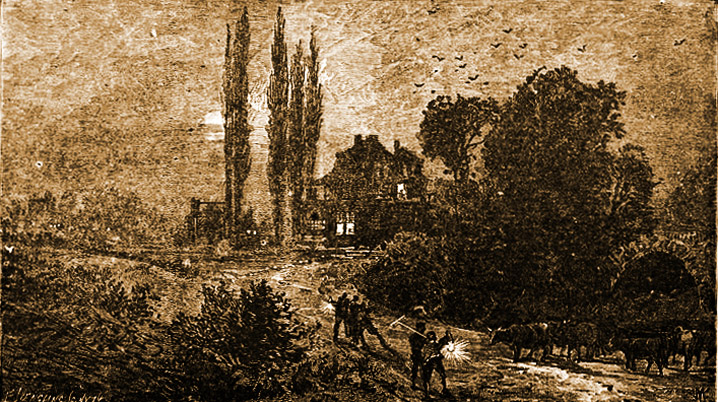
et seq. The ancient wedding sport known in various parts of the British Isles as “riding for the kail,” or “for the broose,”—a pot of spiced broth,—and also called “riding for the ribbon,” took the form in America of riding a dare-devil race over break-neck, half-cleared roads to the house of the bride to secure a beribboned bottle of whiskey. The privileged Protestants had been in Ireland the only subjects permitted to carry or discharge firearms, and they ostentatiously paraded, at every celebration or festivity, their franchised condition by frequent volleys of blank cartridges. Their descendants kept up the same noisy custom in the new land, and the firing of guns formed a large part of a wedding celebration.
A Scotch-Irish marriage in Londonderry was prefaced by widespread formal invitations at least three days previous to the wedding day. An invitation of a single day’s warning was almost an insult. The wedding festivities began by a gathering of the groom’s friends at his home as an escort; the groom and his party proceeded with frequent discharges of musketry at every house they passed, until they met about half way a party of the male friends of the bride. Each group of wedding guests then appointed a champion, who “ran for the bottle” to the bride’s home, and the victorious one returned with it to the advancing party. Upon reaching the scene of the wedding, the bridegroom and his party of friends entered a room, and sat there till the best man brought the bride into the room, and stationed her before the parson by the side of the groom. The best man and the bridesmaid stationed themselves behind the bridal couple, and at a certain point in the ceremony bride and groom each thrust the right hand behind the back and the attendant couple withdrew the gloves, taking care to have the two gloves removed at precisely the same moment. At the end of the ceremony all kissed the bride, and the beribboned bottle of whiskey was not the only one that regaled the company. The bride and groom started on their journey with many parting volleys of musketry. In some neighborhoods, as a further pleasing attention, hidden groups of men discharged blank cartridges from ambush at the bridal pair as they rode through the woods.
Occasionally the wedding bells did not ring smoothly. One Scotch-Irish lassie seized the convenient opportunity, when the rollicking company of her male friends had set out to meet the bridegroom, to mount a pillion behind a young New Hampshire Lochinvar and ride boldly off to a neighboring parson and marry the man of her choice. Such an unpublished marriage was known in New Hampshire as a “Flagg marriage,” from one Parson Flagg, of widespread notoriety, of Chester, Vermont, whose house was a sort of Yankee Gretna Green. The government of New Hampshire, previous to the Revolution, as a means of increasing its income, issued marriage licenses at the price of two guineas each. Sometimes easy going parsons kept a stock of these licenses on hand, ready for issue, at a slightly advanced price, to eloping couples. Such a marriage, without proper public publishing in meeting, was not, however, deemed very reputable.
In some communities still rougher horse-play than unexpected volleys of musketry was shown to the bridal party or to wedding guests. Great trees were felled across bridle-paths, or grapevines were stretched across to obstruct the way, and thus delay the bridal festivities.
A custom prevailed in many New England towns that was doubtless an ameliorated and semi-civilized survival of the customs of savage peoples, when young girls were carried off and made wives by force. A group of those young men who had not been invited to the wedding would invade the house when the marriage ceremony had been performed, and drag away the bride to an inn or some other house, when the groom and his party would follow and rescue her by paying a forfeit of a dinner to the bride-stealers. In western Massachusetts this custom lingered until Revolutionary times; on page 245 of Judd’s “History of Hadley” the names of stolen brides are given. Mrs. Job Marsh, married in 1783, is said to have been the last bride thus stolen. A very rough variation of this custom is reported to be still in vogue in some localities. In the town of Charlestown, Rhode Island, last summer, a very respectable young married woman, a native of the town and wife of a farmer, was asked whether she had ever ridden on the cars. She answered that she had once done so, when she went to Stonington to be married. When asked why she had not been married at home, she said that she knew better than to do that, that the young men of the neighborhood went at dead of night to the house sheltering the newly married couple, pulled them out of bed, and carried the bride downstairs. If the rough invaders found the door locked, they beat it down with an axe.
Madam Sarah Kemble Knights, in her journal of a horseback ride from Boston to New York in 1704, tells of a curious variation of this marriage custom in Connecticut. She writes thus:
They generally marry very young; the males oftener, as I am told, under twenty than above: they generally make public Weddings, and have a way something Singular (as they say) in some of them, viz., just before joining hands the Bridegroom quits the place, who is soon followed by the Brides-men, and, as it were, dragged back to duty—being the reverse to the former practice among us to steal Mistress Bride.
I think this is the most despicable, ungallant bridal custom that I ever heard of, and Connecticut maids must have been poor-spirited, down-trodden jades to endure meekly any such sneaking desertion, an it were merely an empty following of a local fashion. The most eccentric marriage custom that I have noted in America is what has been termed a “smock marriage,” or “marriage in a shift.” It was believed in this country, and in Old England (and I have heard that the notion still prevails in parts of England to this day), that if a widow should wear no garment but a shift at the celebration of her second marriage, her new husband would escape liability for any debt previously contracted by her or by her former husband. Mr. William C. Prime, in his delightful book, “Along New England Roads,” page 25
et seq., gives an account of such a marriage in Newfane, Vermont. In February, 1789, Major Moses Joy married widow Hannah Ward; the bride stood with no clothing on within a closet, and held out her hand to the major through a diamond-shaped hole in the door, and the ceremony was thus performed. She then appeared resplendent in brave wedding attire, which the gallant major had previously deposited in the closet for her assumption. Mr. Prime tells also of a marriage in which the bride, entirely unclad, left her room by a window by night, and, standing on the top round of a high ladder, donned her wedding garments, and thus put off the obligations of the old life.
In some cases the marriage was performed on the public highway. In Hall’s “History of Eastern Vermont,” page 587, we read of a marriage in Westminster, Vermont, in which the widow Lovejoy, while nude and hidden in a chimney recess behind a curtain, wedded Asa Averill. “Smock marriages” are recorded in York, Maine, in 1774, as shown on page 419
et seq. of “History of Wells and Kennebunkport.” It is said that in one case the pitying minister threw his coat over the shivering bride, one widow Mary Bradley, who in February, clad only in a shift, met the bridegroom on the highway, half way from her home to his.
The traveller Kalm, writing in 1748, says that one Pennsylvania bridegroom saved appearances by meeting the scantily-clad widow-bride half way from her house to his, and announcing formally, in the presence of witnesses, that the wedding clothes which he then put on her were only lent to her for the occasion. This is curiously suggestive of the marriage investiture of eastern Hindostan.
In Westerly, Rhode Island, other smock marriages are recorded, showing that the belief in this vulgar error was universal. The most curious variation of this custom is given on page 224, vol. ii. of the “Life of Gustavus Vassa,” wherein that traveller records that he saw a shift marriage take place on a gallows in New York in 1784. A malefactor, condemned to death and about to undergo his execution, was reprieved and liberated through his marriage to a woman thus scantily clad. This traveller’s yarn deserves not, of course, the credence accorded to the previously stated authentic records. In the early days of the colonies a marriage “contraction” or betrothal sometimes took place,—so states Cotton Mather; this custom was abandoned after a few years of life in the New World. It could never have been of any use or much significance, nor, indeed, productive of high moral results.
In a new land, with rude manners of living, many rough courtships are recorded, and some rude methods of wooing. The custom of “bundling” has been for years a standing taunt against New England morality; as a full account of its prevalence, influence, and extent has been given by Dr. Stiles in his book, and more recently and with more fairness by Charles Francis Adams in his paper entitled “Some Phases of Sexual Morality and Church Discipline in Colonial New England,” which was delivered before the Massachusetts Historical Society in June, 1891, I will dwell no further on it here.
A more formal method of courtship is suggested by what is termed a “courting-stick;” one is preserved in Longmeadow, Massachusetts. It is a hollow tube eight feet in length, through which lovers, in the presence of an assembled family, could whisper tender nothings to each other.
Judging from the pages of the Sewall diary of the length of time elapsing between a proposal or agreement of marriage and its consummation, it is evident that short engagements were the mode, and that wedding arrangements were begun as soon as the engagement was announced. I find no indication of the use of betrothal rings, though Judith Sewall’s lover sent her, after her acceptance of his offer, a “stone-ring with a noble letter.” Neither were wedding rings in common use.
Wedding gloves were sent by the bridal couple as gifts to friends, as were mourning gloves at funerals. Judge Sewall records many gifts of gloves from newly-married friends. I have seen old wedding-gloves, gold-laced and fringed, with rich gauntlets, far from an inexpensive gift. I do not learn that it was customary to give presents to the bride, though Judge Sewall tells of his presentation of a psalm-book at a wedding. Bride-cake was made in early days, and was served with cheese at the wedding. A rich wedding feast was frequently given, and the bride was kissed by all present, though I must state that in some parts of New England bride-kissing was discountenanced. So, also, was dancing at weddings, especially at taverns, as “abuses and disorders” arose. This was specially in early days, when marriage was held to be merely a civil contract and was performed by magistrates, not by ministers.
In a community that opened every function—a training, bridge-planning, christening, house-raising, or journeying—with prayer and psalm-singing, it was plain that the benediction of religion would not long be withheld at weddings, and by the close of the seventeenth century the Puritan ministers solemnized marriages.
Curiously enough, the Quakers, professedly simple in living, made a vast deal of celebration of weddings, though the wedding ceremony itself was simply “passing the meeting.” Much feasting took place, and the bride seems to have had to pass through a most trying ordeal of promiscuous and unlimited kissing from every male Quaker for miles around. Visiting the bride was a favorite fashion. We read of one Boston bride, Mrs. Jervis, who received her guests, in 1774, “dressed in a white sattan night gound.”
Other old-time English wedding customs are reported to have been in vogue in New England, such as throwing the stocking of the bride, to be scrambled for as a luck-bearing trophy. Along the coast from Marblehead to Castine, the bridesmaids and unmarried girls strove to steal the bride’s garter by dexterity or craft. At a Pennsylvania Dutch wedding the bride’s shoe was sought for, and the groomsmen protected the bride from the theft, and if ineffectual in their protection were obliged to redeem the shoe with a bottle of wine. I find no record of our modern fashions of throwing slippers and rice after the departing bride.
It is said that along the New Hampshire and upper Massachusetts coast the groom was led to the bridal chamber clad in a brocaded night-gown. This may have occasionally taken place among the gentry, but I fancy brocaded satin night-gowns were not common wear among New England settlers. I have also seen it stated that the bridal chamber was invaded, and healths there were drunk and prayers offered. The only proof of this custom which I have is the negative one which elderly Judge Sewall gives when he states of his own wedding that “none came to us” after he and his bride had retired. There is no reason to suppose, when the wedding of an English nobleman of that period was attended by most indecorous observances, that provincial and colonial weddings were entirely free from similar rude practices, but the greater simplicity of life in the New World naturally crowded out many roystering customs.